
If you are parenting a trans, non-binary, or gender-diverse child, there may come a moment when the questions become more concrete.
Not just Who is my child?
Not just What does this mean?
But What do they need now?
And How do I help?
This is the heart of Phase 4: Transition Decisions in the TransFamily Gender Journey.
For many parents and caregivers, this phase can feel tender, weighty, and deeply overwhelming. You may want to do everything right, while also feeling unsure of what “right” even means. You may be trying to understand social changes, legal paperwork, medical options, school systems, insurance, timelines, providers, family dynamics, and your child’s emotional wellbeing — all at once.
That is a lot to hold.
And if this is where you are right now, we want to say this clearly: you are not failing because this feels big. It is big. It matters. And you do not have to navigate it alone.
At TransFamily Alliance, Phase 4 is what we’ll be exploring in depth this April inside the members-only lobby of our coaching program and community. This conversation is for parents and caregivers who are trying to move from fear and confusion toward grounded, informed support — one thoughtful step at a time.
What making Transition Decisions in Phase 4 really feels like
Phase 4 often begins when love and responsibility meet uncertainty.
You may feel overwhelmed by the complexity of social, medical, and legal transition questions. You may feel exhausted from constantly advocating for your child. You may be worried about whether certain decisions are the right ones, and desperate for trustworthy resources and experienced guidance.
In many ways, this phase asks a lot of caregivers. You are trying to listen to your child, learn quickly, manage your own emotions, and make decisions inside systems that are often confusing, slow, or poorly informed.
Sometimes parents arrive here after moving through earlier phases of the Gender Journey — after learning more about gender, working through grief or doubt, and connecting with community. Other times, families are pushed into Phase 4 more suddenly because their child is in distress, entering puberty, asking for changes now, or needing immediate support at school, home, or in healthcare settings.
And because the Gender Journey is not linear, many parents find themselves in Phase 3 and Phase 4 at the same time— still healing, still integrating, while also being asked to make real-world decisions.
That overlap is normal.
What your child needs from you in this phase
More than anything, your child needs to feel that you are with them.
They need clear communication about what to expect. They need honesty about the steps ahead, the possible obstacles, and the fact that some parts of the process may take time. They need to know that even if you are still learning, you are committed to learning with them.
They also need your willingness to stay present through the challenges.
You do not have to know everything today. You do not have to have every answer. But your child does need to feel your commitment.
That commitment can sound like:
- “I’m going to help you understand your options.”
- “We’re going to find accurate information.”
- “We’ll build the right support team.”
- “We’ll take this seriously.”
- “We’ll keep going, together.”
That kind of steadiness matters more than perfection ever could.
Understanding the three kinds of transition
One of the most important things to remember in Phase 4 is that there is no one-size-fits-all path.
There are three broad areas of transition: social, medical, and legal. Not every child will need all three. Not every child will move through them in the same order. And not every child will want the same things at the same time.
Social transition
Social transition can include changes in name, pronouns, clothing, hairstyle, gender expression, and the way your child is recognized in daily life. For many children — especially younger children — this is the first and sometimes the primary area of transition.
These changes are not superficial. They can significantly reduce distress and help a child feel more accurately seen in the world.
Medical transition
Medical transition looks different depending on your child’s age, development, needs, and goals. It may include puberty blockers, hormone therapy, or later surgical interventions. Some youth will need medical support; others will not.
This is an area where parents often feel the most fear, urgency, or confusion — which is exactly why accurate information and experienced providers matter so much.
Legal transition
Legal transition can involve changing a name and/or gender marker on documents such as school records, identification, insurance, passports, and other formal paperwork. This process varies depending on where you live and, in some cases, where your child was born.
It can take time. It can involve bureaucracy. And it can also be deeply affirming and practically important for safety and dignity.
Following your child’s lead
One of the central truths of this phase is that your child’s needs should guide the process.
That does not mean rushing blindly. It does not mean avoiding thoughtful questions. It means listening carefully and taking seriously the internal experience your child is trying to communicate.
Some youth experience significant gender dysphoria. Others may not describe their experience that way and still clearly need support in order to live more fully as themselves. What matters is not forcing your child into someone else’s timeline or template. What matters is understanding what is happening for your child and responding with care, wisdom, and support.
A transition may happen in small steps. It may happen gradually. It may evolve over time. And it may look very different at age 7, 14, 17, or 24.
This is why parents in Phase 4 need more than opinions. You need a framework. You need trusted resources. You need a place to ask nuanced questions. You need people who understand the systems, the emotional realities, and the many forms a healthy journey can take.
What parents need in Phase 4
In this phase, caregivers need the ability to:
- understand which social, medical, and legal supports their child may need
- evaluate options carefully and make informed decisions
- find accurate information, providers, and resources
- navigate schools, healthcare systems, insurance processes, and legal pathways
- build a trustworthy support team
- learn from people who have already walked this path
Perhaps just as importantly, parents need emotional support for themselves.
Because even when you know supporting your child is the loving thing to do, it can still feel scary. The decisions can feel heavy. The cultural noise can be cruel. The advocacy can be exhausting.
In moments like that, community is not extra. It is essential.
What we’ll be talking about this April
Inside the members-only lobby of our coaching program and community, we’ll be taking a deeper look at Phase 4: Transition Decisions — including how to better understand your child’s needs, how to think about social, medical, and legal transitions, and how to move forward with more confidence and less isolation.
If you’ve been craving a calmer, wiser place to sort through the hard questions, this is exactly the kind of conversation we’re building.
Our coaching and membership experience is built around the TransFamily Gender Journey, with support for each phase along the way. Members also get access to monthly conferences with Dr. Shawn, a private resource library, and recorded interviews with visiting experts so families can keep learning at their own pace.
- If you’re not sure which phase you’re in right now, start with the free Gender Journey Quiz.
- If you’d like to join us in this month’s deeper conversation on Phase 4, you can learn more about the TFA Community here.
- And if medical transition support is one of the questions on your heart right now, we’re also highlighting this replay from our video library: “A Family Caregiver Guide to Gender-Affirming Surgery Support” — an interview with D. Hilton, LCSW and LGBTQ advocate.
A final word for caregivers
If you are in Phase 4, you may feel like every decision carries enormous weight.
Take a breath.
You do not have to solve your child’s whole future today.
You do not have to carry this by yourself.
And you do not have to become an expert overnight.
Your role is not to control your child’s gender. Your role is to help protect their wellbeing, listen deeply, gather wisdom, and walk beside them with increasing clarity and courage.
That is meaningful work.
And in a world that can sometimes feel loud, hostile, or deeply misinformed, your steady presence matters more than ever.
We would be honored to walk this part of the journey with you.
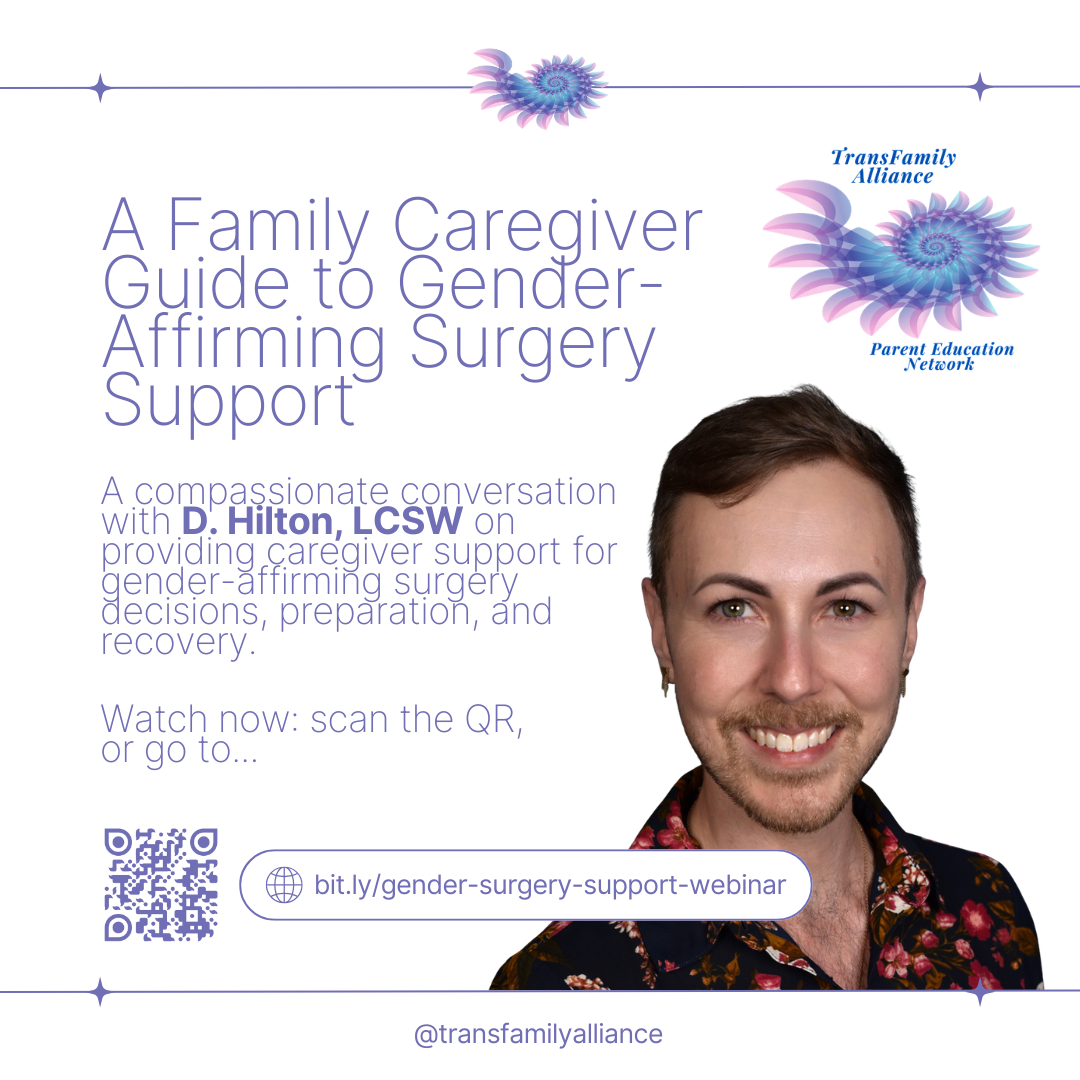
This Month Only: Watch the replay of “A Family Caregiver Guide to Gender-Affirming Surgery Support,” an expert interview with D. Hilton, LCSW, social worker and LGBTQ advocate
This conversation explores how caregivers and supporters can show up for trans young people navigating gender-affirming surgery decisions and recovery — with insight on communication, preparation, post-op support, reducing barriers, and creating a caring recovery environment.
While this interview is normally part of TFA’s exclusive expert interview library for members, we’re opening it up as a free resource for our wider community this month.
Access the webinar replay by scanning the QR code on the graphic or following this link.

If you are parenting a trans, non-binary, or gender-diverse child, there may come a moment when the questions become more concrete.
Not just Who is my child?
Not just What does this mean?
But What do they need now?
And How do I help?
This is the heart of Phase 4: Transition Decisions in the TransFamily Gender Journey.
For many parents and caregivers, this phase can feel tender, weighty, and deeply overwhelming. You may want to do everything right, while also feeling unsure of what “right” even means. You may be trying to understand social changes, legal paperwork, medical options, school systems, insurance, timelines, providers, family dynamics, and your child’s emotional wellbeing — all at once.
That is a lot to hold.
And if this is where you are right now, we want to say this clearly: you are not failing because this feels big. It is big. It matters. And you do not have to navigate it alone.
At TransFamily Alliance, Phase 4 is what we’ll be exploring in depth this April inside the members-only lobby of our coaching program and community. This conversation is for parents and caregivers who are trying to move from fear and confusion toward grounded, informed support — one thoughtful step at a time.
What making Transition Decisions in Phase 4 really feels like
Phase 4 often begins when love and responsibility meet uncertainty.
You may feel overwhelmed by the complexity of social, medical, and legal transition questions. You may feel exhausted from constantly advocating for your child. You may be worried about whether certain decisions are the right ones, and desperate for trustworthy resources and experienced guidance.
In many ways, this phase asks a lot of caregivers. You are trying to listen to your child, learn quickly, manage your own emotions, and make decisions inside systems that are often confusing, slow, or poorly informed.
Sometimes parents arrive here after moving through earlier phases of the Gender Journey — after learning more about gender, working through grief or doubt, and connecting with community. Other times, families are pushed into Phase 4 more suddenly because their child is in distress, entering puberty, asking for changes now, or needing immediate support at school, home, or in healthcare settings.
And because the Gender Journey is not linear, many parents find themselves in Phase 3 and Phase 4 at the same time— still healing, still integrating, while also being asked to make real-world decisions.
That overlap is normal.
What your child needs from you in this phase
More than anything, your child needs to feel that you are with them.
They need clear communication about what to expect. They need honesty about the steps ahead, the possible obstacles, and the fact that some parts of the process may take time. They need to know that even if you are still learning, you are committed to learning with them.
They also need your willingness to stay present through the challenges.
You do not have to know everything today. You do not have to have every answer. But your child does need to feel your commitment.
That commitment can sound like:
- “I’m going to help you understand your options.”
- “We’re going to find accurate information.”
- “We’ll build the right support team.”
- “We’ll take this seriously.”
- “We’ll keep going, together.”
That kind of steadiness matters more than perfection ever could.
Understanding the three kinds of transition
One of the most important things to remember in Phase 4 is that there is no one-size-fits-all path.
There are three broad areas of transition: social, medical, and legal. Not every child will need all three. Not every child will move through them in the same order. And not every child will want the same things at the same time.
Social transition
Social transition can include changes in name, pronouns, clothing, hairstyle, gender expression, and the way your child is recognized in daily life. For many children — especially younger children — this is the first and sometimes the primary area of transition.
These changes are not superficial. They can significantly reduce distress and help a child feel more accurately seen in the world.
Medical transition
Medical transition looks different depending on your child’s age, development, needs, and goals. It may include puberty blockers, hormone therapy, or later surgical interventions. Some youth will need medical support; others will not.
This is an area where parents often feel the most fear, urgency, or confusion — which is exactly why accurate information and experienced providers matter so much.
Legal transition
Legal transition can involve changing a name and/or gender marker on documents such as school records, identification, insurance, passports, and other formal paperwork. This process varies depending on where you live and, in some cases, where your child was born.
It can take time. It can involve bureaucracy. And it can also be deeply affirming and practically important for safety and dignity.
Following your child’s lead
One of the central truths of this phase is that your child’s needs should guide the process.
That does not mean rushing blindly. It does not mean avoiding thoughtful questions. It means listening carefully and taking seriously the internal experience your child is trying to communicate.
Some youth experience significant gender dysphoria. Others may not describe their experience that way and still clearly need support in order to live more fully as themselves. What matters is not forcing your child into someone else’s timeline or template. What matters is understanding what is happening for your child and responding with care, wisdom, and support.
A transition may happen in small steps. It may happen gradually. It may evolve over time. And it may look very different at age 7, 14, 17, or 24.
This is why parents in Phase 4 need more than opinions. You need a framework. You need trusted resources. You need a place to ask nuanced questions. You need people who understand the systems, the emotional realities, and the many forms a healthy journey can take.
What parents need in Phase 4
In this phase, caregivers need the ability to:
- understand which social, medical, and legal supports their child may need
- evaluate options carefully and make informed decisions
- find accurate information, providers, and resources
- navigate schools, healthcare systems, insurance processes, and legal pathways
- build a trustworthy support team
- learn from people who have already walked this path
Perhaps just as importantly, parents need emotional support for themselves.
Because even when you know supporting your child is the loving thing to do, it can still feel scary. The decisions can feel heavy. The cultural noise can be cruel. The advocacy can be exhausting.
In moments like that, community is not extra. It is essential.
What we’ll be talking about this April
Inside the members-only lobby of our coaching program and community, we’ll be taking a deeper look at Phase 4: Transition Decisions — including how to better understand your child’s needs, how to think about social, medical, and legal transitions, and how to move forward with more confidence and less isolation.
If you’ve been craving a calmer, wiser place to sort through the hard questions, this is exactly the kind of conversation we’re building.
Our coaching and membership experience is built around the TransFamily Gender Journey, with support for each phase along the way. Members also get access to monthly conferences with Dr. Shawn, a private resource library, and recorded interviews with visiting experts so families can keep learning at their own pace.
- If you’re not sure which phase you’re in right now, start with the free Gender Journey Quiz.
- If you’d like to join us in this month’s deeper conversation on Phase 4, you can learn more about the TFA Community here.
- And if medical transition support is one of the questions on your heart right now, we’re also highlighting this replay from our video library: “A Family Caregiver Guide to Gender-Affirming Surgery Support” — an interview with D. Hilton, LCSW and LGBTQ advocate.
A final word for caregivers
If you are in Phase 4, you may feel like every decision carries enormous weight.
Take a breath.
You do not have to solve your child’s whole future today.
You do not have to carry this by yourself.
And you do not have to become an expert overnight.
Your role is not to control your child’s gender. Your role is to help protect their wellbeing, listen deeply, gather wisdom, and walk beside them with increasing clarity and courage.
That is meaningful work.
And in a world that can sometimes feel loud, hostile, or deeply misinformed, your steady presence matters more than ever.
We would be honored to walk this part of the journey with you.

This Month Only: Watch the replay of “A Family Caregiver Guide to Gender-Affirming Surgery Support,” an expert interview with D. Hilton, LCSW, social worker and LGBTQ advocate
This conversation explores how caregivers and supporters can show up for trans young people navigating gender-affirming surgery decisions and recovery — with insight on communication, preparation, post-op support, reducing barriers, and creating a caring recovery environment.
While this interview is normally part of TFA’s exclusive expert interview library for members, we’re opening it up as a free resource for our wider community this month.
Access the webinar replay by scanning the QR code on the graphic or following this link.


