If you’re reading this as a parent or caregiver of a trans, non-binary, or gender-diverse young person, I want to start with a gentle truth:
You don’t have to understand everything right now to be a loving, steady support.
Phase 2 of the TransFamily Gender Journey is called Gender Informed, and it’s the place many families arrive once the initial shock wears off and the questions begin to stack up. For many parents, Phase 2 sounds like:
- “What does this mean?”
- “Is this a phase… or is it something deeper?”
- “What’s real, what’s necessary, and what’s just noise?”
- “How do I help my kid without making mistakes?”
And in the current cultural climate—where loud, aggressive misinformation about LGBTQ+ lives circulates easily—it can feel like trying to drink from a firehose while someone is shouting in your ear.
This month inside our coaching program’s members-only lobby, we’re going to slow it all down and explore Phase 2: Gender Informed in depth—together, in community, with care. Our coaching program and community is now accepting new applications, and you’re warmly invited to join us in the conversation: Learn about the community and apply here.
What Phase 2 feels like (and why it makes sense)
Phase 2 often comes with confusion—not because you’re behind, but because gender is complex and most of us didn’t receive accurate education about it. Many parents are trying to piece together understanding from TV storylines, social media takes, political debates, and well-meaning opinions from friends or family.
Unfortunately, a lot of what’s “common knowledge” is outdated, biased, or simply incorrect. Fear-based messaging spreads fast, but it isn’t the same thing as truth.
Phase 2 is the moment you begin to say:
“Okay. Gender is part of my child’s reality. I need real information so I can respond with wisdom and love.”
That’s not just brave. It’s protective.
The three milestones of becoming Gender Informed
In Phase 2, your job isn’t to “have the perfect answer.” Your job is to get oriented—with accuracy, compassion, and a sturdy inner compass. Here are the three big milestones we’ll be focusing on:
1) Gender 101: Understanding the construct of gender
This is where many myths begin to dissolve. You start learning core concepts like:
- Gender identity (who I am)
- Gender expression (how I show it)
- Biological sex (a complex set of traits—not just two boxes)
- Sexual orientation (who I’m attracted to—different from gender identity)
You’ll also learn why language matters so much. Pronouns and affirming terms aren’t “just words.” Language is one of the primary ways we communicate belief, respect, and reality. When a child is repeatedly misgendered, the message they often receive is: “I don’t see you.” And that can be deeply painful.
In Phase 2, many parents begin building new language habits—not to be “perfect,” but to be connected.
2) Understanding how gender develops—especially for your child
The second milestone is learning how gender develops in general, and how trans, non-binary, and gender-expansive people often experience that development.
This knowledge helps you make sense of your child’s story—what may have been true internally long before it was spoken out loud.
And it comes with an important reminder: the best source of information about your child’s experience is still… your child.
Phase 2 is where parents often practice new skills like active listening, repair (if Phase 1 was rocky), and building trust through consistency. You don’t need a flawless script. You need presence, humility, and a willingness to learn.
3) Learning the landscape of transition options (without rushing decisions)
The third milestone can feel big: understanding social, legal, and medical transitions.
Let’s name something clearly: learning about options is not the same as choosing options.
Phase 2 is information-gathering—not decision-making.
Every child’s path is different. Some only need social shifts (name, pronouns, presentation). Others may eventually explore legal or medical supports. Your role in Phase 2 is to understand what exists, how it works, and who you would consult if your family needed guidance later.
This is also where many parents begin to build a gender support team—trusted professionals and informed community supports who can help your family navigate thoughtfully.
What your child needs most from you in Phase 2
In this phase, kids often don’t need you to be an expert.
They need you to be in motion.
They need to see that you are:
- taking steps to support them
- learning actively
- coming back to them with what you’re discovering
- staying emotionally present—even when you’re still figuring it out
A steady, curious caregiver is a powerful protective factor.
What you need in Phase 2 (and why community matters)
Parents in Phase 2 deserve support too. You may need:
- credible, science-informed information (without sensationalism)
- help sorting through conflicting “expert” opinions
- space to process your own emotions without judgment
- guidance on building a gender team
- a calm place to ask the questions you’re afraid to ask anywhere else
That’s exactly what our coaching and membership community is designed for: to help you move from confusion to clarity, and from fear to grounded support.
If you’d like to join us for this month’s deep dive into Phase 2, you can learn more and apply here: TFA Coaching Program + Community Details.
And if you’re not sure which Phase you’re currently in, start with our free quiz:
Find your phase of the Gender Journey
Free for everyone this month: “Beyond Pronouns” with Tammy Plunkett
One more loving invitation: this month we’re sharing a free replay from our archives:
Beyond Pronouns: A Mother’s Journey to Affirming Her Trans Child with Tammy Plunkett.
This conversation is open to everyone, and it offers the kind of grounded, lived-experience perspective that can be especially reassuring in Phase 2—when you’re trying to translate information into real-life parenting.
And for our members: this is just one of dozens. Inside the community, you’ll have access to a private resource library with recorded expert interviews, plus monthly conferences with Dr. Shawn and an ongoing conversation space with other families walking this journey.
A closing breath
If Phase 2 has you feeling overwhelmed, please hear this:
Seeking accurate information is not panic.
It’s devotion.
You’re not “late.” You’re learning. And your willingness to learn—especially in a world that can be loud and cruel—matters more than you know.
When you’re ready, we’d love to welcome you into the community.
Take the quiz to find your phase: Gender Journey Quiz
Join the conversation and explore Phase 2 with us this month: Community + Applications
Free Webinar Access: “Beyond Pronouns: A Mother’s Journey to Affirming Her Trans Child”
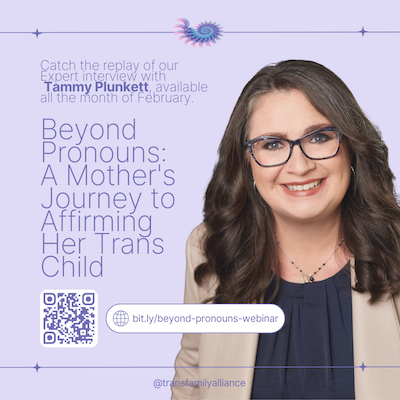 In this free replay, Tammy Plunkett (Beyond Pronouns) discusses:
✔️ child-led self-discovery + “mirroring”
✔️ gender dysphoria support
✔️ nonbinary identities
✔️ advocacy for names/pronouns
✔️ parent self-care + unpacking values/internalized transphobia
This interview is part of the TFA private expert library — and we’re sharing it free to support Phase 2: Gender Informed.
Click here, or scan the QR code to access the interview!
If you’re reading this as a parent or caregiver of a trans, non-binary, or gender-diverse young person, I want to start with a gentle truth:
You don’t have to understand everything right now to be a loving, steady support.
Phase 2 of the TransFamily Gender Journey is called Gender Informed, and it’s the place many families arrive once the initial shock wears off and the questions begin to stack up. For many parents, Phase 2 sounds like:
- “What does this mean?”
- “Is this a phase… or is it something deeper?”
- “What’s real, what’s necessary, and what’s just noise?”
- “How do I help my kid without making mistakes?”
And in the current cultural climate—where loud, aggressive misinformation about LGBTQ+ lives circulates easily—it can feel like trying to drink from a firehose while someone is shouting in your ear.
This month inside our coaching program’s members-only lobby, we’re going to slow it all down and explore Phase 2: Gender Informed in depth—together, in community, with care. Our coaching program and community is now accepting new applications, and you’re warmly invited to join us in the conversation: Learn about the community and apply here.
What Phase 2 feels like (and why it makes sense)
Phase 2 often comes with confusion—not because you’re behind, but because gender is complex and most of us didn’t receive accurate education about it. Many parents are trying to piece together understanding from TV storylines, social media takes, political debates, and well-meaning opinions from friends or family.
Unfortunately, a lot of what’s “common knowledge” is outdated, biased, or simply incorrect. Fear-based messaging spreads fast, but it isn’t the same thing as truth.
Phase 2 is the moment you begin to say:
“Okay. Gender is part of my child’s reality. I need real information so I can respond with wisdom and love.”
That’s not just brave. It’s protective.
The three milestones of becoming Gender Informed
In Phase 2, your job isn’t to “have the perfect answer.” Your job is to get oriented—with accuracy, compassion, and a sturdy inner compass. Here are the three big milestones we’ll be focusing on:
1) Gender 101: Understanding the construct of gender
This is where many myths begin to dissolve. You start learning core concepts like:
- Gender identity (who I am)
- Gender expression (how I show it)
- Biological sex (a complex set of traits—not just two boxes)
- Sexual orientation (who I’m attracted to—different from gender identity)
You’ll also learn why language matters so much. Pronouns and affirming terms aren’t “just words.” Language is one of the primary ways we communicate belief, respect, and reality. When a child is repeatedly misgendered, the message they often receive is: “I don’t see you.” And that can be deeply painful.
In Phase 2, many parents begin building new language habits—not to be “perfect,” but to be connected.
2) Understanding how gender develops—especially for your child
The second milestone is learning how gender develops in general, and how trans, non-binary, and gender-expansive people often experience that development.
This knowledge helps you make sense of your child’s story—what may have been true internally long before it was spoken out loud.
And it comes with an important reminder: the best source of information about your child’s experience is still… your child.
Phase 2 is where parents often practice new skills like active listening, repair (if Phase 1 was rocky), and building trust through consistency. You don’t need a flawless script. You need presence, humility, and a willingness to learn.
3) Learning the landscape of transition options (without rushing decisions)
The third milestone can feel big: understanding social, legal, and medical transitions.
Let’s name something clearly: learning about options is not the same as choosing options.
Phase 2 is information-gathering—not decision-making.
Every child’s path is different. Some only need social shifts (name, pronouns, presentation). Others may eventually explore legal or medical supports. Your role in Phase 2 is to understand what exists, how it works, and who you would consult if your family needed guidance later.
This is also where many parents begin to build a gender support team—trusted professionals and informed community supports who can help your family navigate thoughtfully.
What your child needs most from you in Phase 2
In this phase, kids often don’t need you to be an expert.
They need you to be in motion.
They need to see that you are:
- taking steps to support them
- learning actively
- coming back to them with what you’re discovering
- staying emotionally present—even when you’re still figuring it out
A steady, curious caregiver is a powerful protective factor.
What you need in Phase 2 (and why community matters)
Parents in Phase 2 deserve support too. You may need:
- credible, science-informed information (without sensationalism)
- help sorting through conflicting “expert” opinions
- space to process your own emotions without judgment
- guidance on building a gender team
- a calm place to ask the questions you’re afraid to ask anywhere else
That’s exactly what our coaching and membership community is designed for: to help you move from confusion to clarity, and from fear to grounded support.
If you’d like to join us for this month’s deep dive into Phase 2, you can learn more and apply here: TFA Coaching Program + Community Details.
And if you’re not sure which Phase you’re currently in, start with our free quiz:
Find your phase of the Gender Journey
Free for everyone this month: “Beyond Pronouns” with Tammy Plunkett
One more loving invitation: this month we’re sharing a free replay from our archives:
Beyond Pronouns: A Mother’s Journey to Affirming Her Trans Child with Tammy Plunkett.
This conversation is open to everyone, and it offers the kind of grounded, lived-experience perspective that can be especially reassuring in Phase 2—when you’re trying to translate information into real-life parenting.
And for our members: this is just one of dozens. Inside the community, you’ll have access to a private resource library with recorded expert interviews, plus monthly conferences with Dr. Shawn and an ongoing conversation space with other families walking this journey.
A closing breath
If Phase 2 has you feeling overwhelmed, please hear this:
Seeking accurate information is not panic.
It’s devotion.
You’re not “late.” You’re learning. And your willingness to learn—especially in a world that can be loud and cruel—matters more than you know.
When you’re ready, we’d love to welcome you into the community.
Take the quiz to find your phase: Gender Journey Quiz
Join the conversation and explore Phase 2 with us this month: Community + Applications
Free Webinar Access: “Beyond Pronouns: A Mother’s Journey to Affirming Her Trans Child”
In this free replay, Tammy Plunkett (Beyond Pronouns) discusses:
✔️ child-led self-discovery + “mirroring”
✔️ gender dysphoria support
✔️ nonbinary identities
✔️ advocacy for names/pronouns
✔️ parent self-care + unpacking values/internalized transphobia
This interview is part of the TFA private expert library — and we’re sharing it free to support Phase 2: Gender Informed.
Click here, or scan the QR code to access the interview!