
January can feel like a reset—an invitation to take stock, breathe, and figure out what’s real. For many parents of gender-diverse and transgender kids, that “reset” isn’t about new habits or planners. It’s about a moment (or a series of moments) when you realize: Gender is a real issue for my child—and I don’t yet know what that means for our family.
That’s why our January 2026 monthly theme is Gender Phase 1: Gender Awareness, based on Phase 1 of the TransFamily Gender Journey. This is the phase many parents enter when their child shares something new about their gender identity—or when you begin noticing signs that your child is wrestling with gender internally, even if they aren’t naming it clearly yet.
Throughout January, we’ll be exploring Phase 1 in-depth in the members-only lobby of our parent coaching program, Navigating the Gender Journey, which is now accepting new applications. (More on that below.)
First, what is the TransFamily Gender Journey?
The TransFamily Gender Journey is a framework that helps parents understand the emotional and practical stages that often arise when your child is on a gender journey. Some parents find the framework comforting because it creates language for experiences that can feel chaotic or isolating. Others recognize certain phases immediately—especially Phase 4: Transition Decisions, when choices about social changes, names/pronouns, school plans, or medical considerations may suddenly feel urgent.
But the truth is: many families don’t start at the “beginning.” Your child may have been quietly navigating their own internal gender journey for years before you ever knew. That can mean you, as a parent, may be in Phase 1 while your child feels like they’re already far ahead. This mismatch is common—and it’s one reason Phase 1 deserves care, attention, and support.
If you’re not sure which phase you’re in, you can take our free quiz here!
What Phase 1 (Gender Awareness) often feels like
Phase 1 is often emotional, tender, and disorienting. It may include feelings like:
- Denial (“This can’t be true.” “It’s probably just a phase.”)
- Confusion (“How did we miss this?” “Why now?”)
- Fear and sadness (“I’m scared for their future.” “Will life be harder?”)
- Blame (directed at yourself, your child, the internet, peers, culture—anywhere your mind tries to put the discomfort)
- Attempts to stall or delay (“Let’s wait.” “Let’s not talk about this yet.”)
- Taking responsibility for your child’s gender (“Did I cause this?” “Did we do something wrong?”)
If any of these feel familiar, you’re not alone—and you’re not “behind.” This is a very human response to uncertainty, grief, fear, and the collision between what you expected and what you’re being asked to understand now.
Many parents also feel pressure to become an expert overnight. You may feel like you need to make the right decisions immediately while still trying to wrap your mind around what’s happening. That pressure can be intense—especially if your child is in distress or expressing urgency.
Key milestones of Phase 1
Phase 1 isn’t about having a perfect response. It’s about reaching a few essential milestones that create stability for both you and your child:
- Recognizing that gender is a real issue for your child.
Even if your child is still questioning, even if their expression is inconsistent, even if you don’t understand it yet—acknowledging that this matters to them is foundational. - Letting go of denial, bargaining, or anger that may show up.
These reactions are common, especially when fear is present. But staying stuck in them can increase conflict and isolation. - Letting go of responsibility for your child’s gender identity.
Your child’s internal sense of self isn’t something you created or can control. One of the biggest shifts in Phase 1 is moving from “How do I fix this?” to “How do I support my child’s health?”
What your child needs from you in Phase 1
Even if you’re unsure, overwhelmed, or scared, your child needs three simple (but powerful) things:
- Active listening: letting them talk without interrogating, correcting, or rushing to conclusions.
- Validation of their feelings: you don’t have to fully understand to say, “I hear you,” “That sounds hard,” or “Thank you for telling me.”
- Your willingness to go on the journey with them: the message is, “You’re not alone. We’ll figure this out together.”
For many kids, telling a parent is a high-stakes moment. Some have known for years and tried to hide it—especially if they’ve absorbed messages from peers, media, school, or even family that being gender-diverse is “a problem.” Others came out young and were dismissed as “too young to know,” which can teach them to go underground. Some don’t struggle much until puberty or until gender expectations tighten socially, and then distress can spike quickly.
Whatever your child’s path, by the time they bring you into it, they’ve often been carrying a lot—alone. When a parent can acknowledge and validate their feelings, it reduces isolation and can significantly support mental health.
What you need in Phase 1
You also deserve support—because Phase 1 can feel like you’re carrying a private storm.
One of the clearest needs in this phase is: someone to share your feelings with who will understand and not judge you. That might be a trained coach, a support group, a therapist who is truly gender-competent, or a community of parents who “get it.” The key is not doing this alone—and not forcing your child to be your primary emotional support while they’re still figuring themselves out.
What helps you move into Phase 2: Gender Informed
Phase 2 requires a shift from “Is this real?” to “This is real enough to respond to with care.” Moving forward usually involves:
- Awareness and acceptance that your kid is on some kind of gender journey
- Letting go of denial, anger, and stalling (often linked to fear and grief)
- Understanding what you can and can’t control: you have very little control over your child’s internal identity, but you have a lot of influence over their safety, support, and gender health
You don’t have to jump ahead to Phase 4 questions before you’re ready. But you can start building a foundation right now—through listening, validation, and grounded support for both you and your child.
Join us in the members-only lobby this January
All month long, we’ll be unpacking Phase 1: Gender Awareness inside our members-only lobby–exclusive to current and former participants of our coaching program, Navigating the Gender Journey. Join us for practical guidance, emotional support, and a place to process what’s coming up without judgment.
If you’re a parent thinking, “I love my kid, but I’m overwhelmed and I don’t know what to do next,” this space is for you!
No matter where you’re starting, you don’t have to navigate this alone.
✅ Apply now for Navigating the Gender Journey — re-launching February 5, 2026!
✅ Not sure what phase you’re in? Take the free quiz!
Free Webinar Access: “Making Sense of the Gender Journey & Your Next Steps As a Parent”
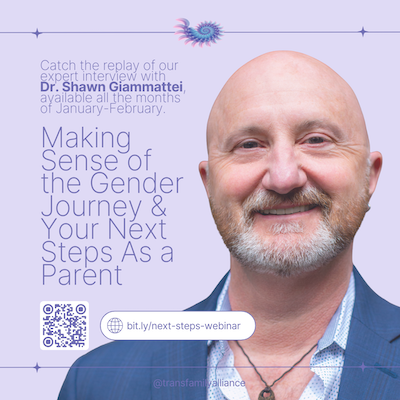 Catch the replay of this recorded interview with our founder, Dr. Shawn Giammattei (clinical psychologist, gender specialist, and founder of the TransFamily Alliance).
Inside, Dr. Shawn covers:
• gender identity development (including nonbinary experiences)
• the impact of societal attitudes and media
• resilience and support amid discrimination
• why parent connection + specialized support matters
Click here, or scan the QR to access the webinar!
January can feel like a reset—an invitation to take stock, breathe, and figure out what’s real. For many parents of gender-diverse and transgender kids, that “reset” isn’t about new habits or planners. It’s about a moment (or a series of moments) when you realize: Gender is a real issue for my child—and I don’t yet know what that means for our family.
That’s why our January 2026 monthly theme is Gender Phase 1: Gender Awareness, based on Phase 1 of the TransFamily Gender Journey. This is the phase many parents enter when their child shares something new about their gender identity—or when you begin noticing signs that your child is wrestling with gender internally, even if they aren’t naming it clearly yet.
Throughout January, we’ll be exploring Phase 1 in-depth in the members-only lobby of our parent coaching program, Navigating the Gender Journey, which is now accepting new applications. (More on that below.)
First, what is the TransFamily Gender Journey?
The TransFamily Gender Journey is a framework that helps parents understand the emotional and practical stages that often arise when your child is on a gender journey. Some parents find the framework comforting because it creates language for experiences that can feel chaotic or isolating. Others recognize certain phases immediately—especially Phase 4: Transition Decisions, when choices about social changes, names/pronouns, school plans, or medical considerations may suddenly feel urgent.
But the truth is: many families don’t start at the “beginning.” Your child may have been quietly navigating their own internal gender journey for years before you ever knew. That can mean you, as a parent, may be in Phase 1 while your child feels like they’re already far ahead. This mismatch is common—and it’s one reason Phase 1 deserves care, attention, and support.
If you’re not sure which phase you’re in, you can take our free quiz here!
What Phase 1 (Gender Awareness) often feels like
Phase 1 is often emotional, tender, and disorienting. It may include feelings like:
- Denial (“This can’t be true.” “It’s probably just a phase.”)
- Confusion (“How did we miss this?” “Why now?”)
- Fear and sadness (“I’m scared for their future.” “Will life be harder?”)
- Blame (directed at yourself, your child, the internet, peers, culture—anywhere your mind tries to put the discomfort)
- Attempts to stall or delay (“Let’s wait.” “Let’s not talk about this yet.”)
- Taking responsibility for your child’s gender (“Did I cause this?” “Did we do something wrong?”)
If any of these feel familiar, you’re not alone—and you’re not “behind.” This is a very human response to uncertainty, grief, fear, and the collision between what you expected and what you’re being asked to understand now.
Many parents also feel pressure to become an expert overnight. You may feel like you need to make the right decisions immediately while still trying to wrap your mind around what’s happening. That pressure can be intense—especially if your child is in distress or expressing urgency.
Key milestones of Phase 1
Phase 1 isn’t about having a perfect response. It’s about reaching a few essential milestones that create stability for both you and your child:
- Recognizing that gender is a real issue for your child.
Even if your child is still questioning, even if their expression is inconsistent, even if you don’t understand it yet—acknowledging that this matters to them is foundational. - Letting go of denial, bargaining, or anger that may show up.
These reactions are common, especially when fear is present. But staying stuck in them can increase conflict and isolation. - Letting go of responsibility for your child’s gender identity.
Your child’s internal sense of self isn’t something you created or can control. One of the biggest shifts in Phase 1 is moving from “How do I fix this?” to “How do I support my child’s health?”
What your child needs from you in Phase 1
Even if you’re unsure, overwhelmed, or scared, your child needs three simple (but powerful) things:
- Active listening: letting them talk without interrogating, correcting, or rushing to conclusions.
- Validation of their feelings: you don’t have to fully understand to say, “I hear you,” “That sounds hard,” or “Thank you for telling me.”
- Your willingness to go on the journey with them: the message is, “You’re not alone. We’ll figure this out together.”
For many kids, telling a parent is a high-stakes moment. Some have known for years and tried to hide it—especially if they’ve absorbed messages from peers, media, school, or even family that being gender-diverse is “a problem.” Others came out young and were dismissed as “too young to know,” which can teach them to go underground. Some don’t struggle much until puberty or until gender expectations tighten socially, and then distress can spike quickly.
Whatever your child’s path, by the time they bring you into it, they’ve often been carrying a lot—alone. When a parent can acknowledge and validate their feelings, it reduces isolation and can significantly support mental health.
What you need in Phase 1
You also deserve support—because Phase 1 can feel like you’re carrying a private storm.
One of the clearest needs in this phase is: someone to share your feelings with who will understand and not judge you. That might be a trained coach, a support group, a therapist who is truly gender-competent, or a community of parents who “get it.” The key is not doing this alone—and not forcing your child to be your primary emotional support while they’re still figuring themselves out.
What helps you move into Phase 2: Gender Informed
Phase 2 requires a shift from “Is this real?” to “This is real enough to respond to with care.” Moving forward usually involves:
- Awareness and acceptance that your kid is on some kind of gender journey
- Letting go of denial, anger, and stalling (often linked to fear and grief)
- Understanding what you can and can’t control: you have very little control over your child’s internal identity, but you have a lot of influence over their safety, support, and gender health
You don’t have to jump ahead to Phase 4 questions before you’re ready. But you can start building a foundation right now—through listening, validation, and grounded support for both you and your child.
Join us in the members-only lobby this January
All month long, we’ll be unpacking Phase 1: Gender Awareness inside our members-only lobby–exclusive to current and former participants of our coaching program, Navigating the Gender Journey. Join us for practical guidance, emotional support, and a place to process what’s coming up without judgment.
If you’re a parent thinking, “I love my kid, but I’m overwhelmed and I don’t know what to do next,” this space is for you!
No matter where you’re starting, you don’t have to navigate this alone.
✅ Apply now for Navigating the Gender Journey — re-launching February 5, 2026!
✅ Not sure what phase you’re in? Take the free quiz!
Free Webinar Access: “Making Sense of the Gender Journey & Your Next Steps As a Parent”
Catch the replay of this recorded interview with our founder, Dr. Shawn Giammattei (clinical psychologist, gender specialist, and founder of the TransFamily Alliance).
Inside, Dr. Shawn covers:
• gender identity development (including nonbinary experiences)
• the impact of societal attitudes and media
• resilience and support amid discrimination
• why parent connection + specialized support matters
Click here, or scan the QR to access the webinar!